
A buyer-side guide to 3D, 5D, 6D and 9D screen protectors — what the numbers actually describe, what they cost you, and how to write a specification that a factory can be held to.
Here is the uncomfortable answer to the question most buyers open with: there is no standard that defines 5D, 6D or 9D. No IEC clause, no GB number, no ISO document. Only 2.5D has anything close to an agreed meaning. The rest are grades that individual suppliers invented to describe their own tooling, and the same "9D" from two factories can be two different products. That does not mean the numbers are meaningless — it means they are adjectives, not specifications. This guide translates them back into the six things you can actually measure, test and put in a purchase order.
1. Are 3D, 5D, 6D and 9D Official Standards?
No. This is worth stating plainly, because procurement documents are regularly written as if they were. Search any national or international standards catalogue for "9D tempered glass" and you will find nothing. What you will find is a marketing vocabulary that grew out of 2.5D — the one term with a broadly shared physical meaning — and then extended itself into numbers that sounded progressively more advanced.
2.5D describes a flat glass body with a machined, rounded edge. The "2.5" is a compromise: it is not a flat 2D sheet, and it is not a fully three-dimensional formed shape. That definition is loose but workable, and most of the industry understands it the same way. Once you pass 3D, the sequence stops tracking any physical property. A 5D protector is not "five dimensions". A 9D protector is not "nine".
| Term | Defined by a standard? | What the industry generally means | Can you test it? |
| 2.5D | No formal standard, but a shared convention | Flat body, CNC-ground and polished edge radius; covers the display area, stops at the edge | Yes — edge radius, coverage dimensions, edge polish |
| 3D | No | Hot-formed glass whose edge curves continuously away from the flat centre, following the phone's own curvature | Yes — sag height, curvature radius, edge fit gap |
| 5D | No | Usually 3D forming with a printed black border that masks the adhesive line; occasionally a larger curve | Only by asking which of the two it is |
| 6D | No | Usually edge wrap plus full-surface adhesive, so the glass follows the side of the device | Yes — adhesive coverage, wrap extent |
| 9D | No | The most coverage a given factory offers: full curve, printed border, full glue, cut-outs for earpiece and sensors | Yes — but only if you define coverage, glue and border width |
The practical consequence is simple and slightly annoying: a quotation that says "9D" has told you nothing you can reject a shipment against. A quotation that says "hot-bent, 0.55 mm sag over 3.2 mm edge radius, full AB glue, 1.0 mm printed border, cut-outs per drawing" has told you everything. The rest of this article is about getting from the first kind of quotation to the second.
2. What Does Each Number Actually Change?
Strip away the naming and only three physical variables move as the number goes up. Everything else is downstream of them.
First, how the edge is made. A 2.5D edge is cut and mechanically ground. A 3D edge is formed hot, with the glass sagging into or over a mould at a temperature where it can deform without crystallising. These are different factories in some cases, and always different cost structures. Second, how far the glass extends. Stopping at the display edge, covering the bezel, or wrapping onto the side wall are three different products with three different fit problems. Third, how the adhesive is distributed. A full-surface adhesive layer and an edge-only ring behave completely differently once the glass is curved.
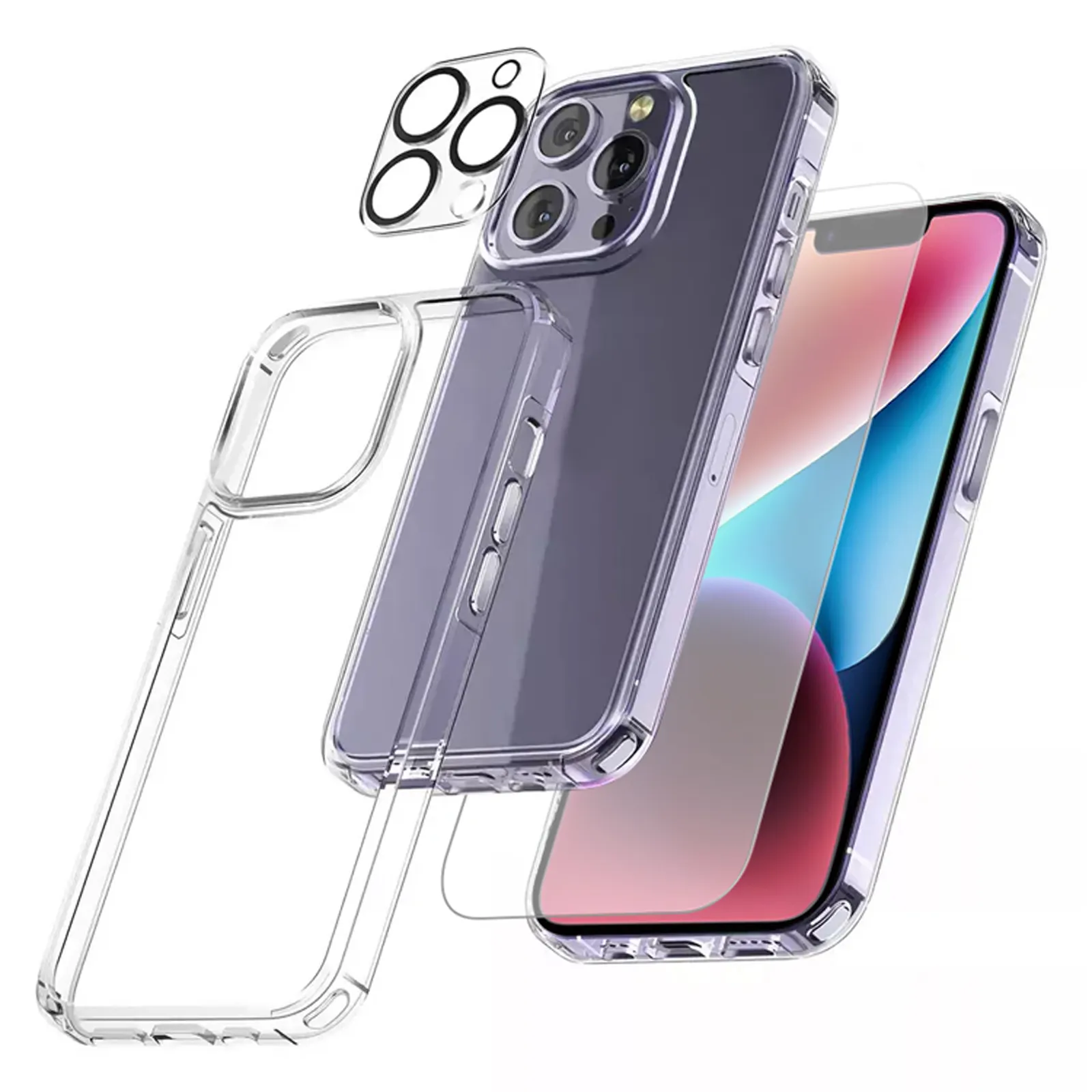
A current example from our own range makes the point. The TPU case with HD screen protector and camera lens protector for iPhone 12–15 series uses Japanese AGC glass with AB glue, is specified as 3D/5D/6D/9D full-curved coverage depending on configuration, and carries a 9H hardness claim alongside a measured 64 g steel ball drop test and a water contact angle that starts above 115°±2 and stays at or below 105°±2 after 3,000 rubs. Those last two numbers are worth more than the D label, because you can reproduce them. The D label merely tells you which tooling was used.
3. Is a Higher Number Always Better?
No, and this is where a lot of buyers overspend. A higher grade buys coverage, and coverage has three costs that do not appear on the quotation until after you have committed.
Cost one: the border. To hide the adhesive line on a curved edge, the factory prints an opaque black frame. The wider that frame, the more of your display it covers. On a phone with narrow bezels, a 1.5 mm border can eat a visible fraction of the viewable area, and buyers notice it in reviews even when the spec sheet does not mention it.
Cost two: case compatibility. A protector that wraps onto the side wall occupies the exact space a case's lip needs. The two products then fight for the same millimetre. If you are supplying a case brand, a maximum-coverage protector is often the wrong choice regardless of what the marketing department wants.
Cost three: yield. Hot bending a tighter curve means more scrap. Full-surface adhesive on a curved part means more bubble rejects. Both are real costs that come back to you as either a higher unit price or a longer lead time, and neither shows up in the grade name.
The honest rule is: choose the lowest coverage that solves your actual problem. If the device lives in a case, the protector's job is to protect the display, not the bezel. If it is sold bare as a retail kit, the wrap is part of what the customer is paying for.
4. Full Glue or Edge Glue — Where Do the Bubbles Come From?
This is the single most useful question you can ask after "which grade", and it is the one that most quotations omit. Two protectors can share a grade name, a glass supplier and a thickness, and still differ by an adhesive construction that decides whether the product feels premium or defective.
Edge glue places an adhesive ring around the perimeter only. The centre of the glass floats a few microns above the screen. It is cheap, it installs easily, and it is acceptable on a flat 2.5D part. On a curved or wrapped part it is a liability: the unsupported centre creates a visible interference pattern, touch response can soften at the edges, and the gap becomes a dust trap over months of use.
Full glue — what the industry calls AB glue, a silicone self-wetting layer combined with an optical adhesive layer — covers the entire glass surface. It conforms to the display, transmits touch reliably and eliminates the floating-centre effect. It also demands a controlled lamination process, because air has nowhere to escape except the edges, and a poorly controlled press will leave trapped bubbles that only appear after 24 hours.
So the specification has to do two things at once: state the adhesive type, and define what counts as an acceptable bubble. "No bubbles" is not a workable inspection criterion, because no lamination process achieves literally zero. A usable clause defines diameter, count and zone — for example, no bubble larger than 0.3 mm, no more than two per unit, none within the active display area. Agree the numbers before the first shipment, not after the first complaint.
| Attribute | Edge glue | Full glue (AB) |
| Where the adhesive sits | Perimeter ring only | Entire glass surface |
| Curved coverage | Poor — centre lifts on curvature | Good — conforms to the display |
| Typical defect | Rainbow pattern, dust ingress, soft touch at edges | Trapped bubbles if lamination is not controlled |
| Installation difficulty | Low | Higher; alignment must be right first time |
| Cost | Lower | Higher material and process cost |
5. What Does a 115° Contact Angle Actually Prove?
Oleophobic coating is the difference between a screen that wipes clean and one that keeps a permanent map of your thumb. It is also one of the easiest claims to fake, because a brand-new sample will pass almost any threshold. The number that matters is not the initial angle — it is the angle after wear.
The specification on our AGC glass product states two values: before rubbing, greater than 115°±2; after 3,000 rubs, at or below 105°±2. Read as a pair, that is a meaningful acceptance criterion, because it fixes both the starting performance and the loss allowed. Read alone, the 115° figure tells you only that the coating was applied.
Three details determine whether a reported value can be reproduced. The wear medium — steel wool, eraser, or a defined abrasive paper — changes the result enormously. The load and stroke count must be stated, not just the count. The measurement liquid and drop volume matter too, though these are usually standardised once the first two are fixed. If a supplier gives you a contact angle without the wear conditions, you have a marketing figure, not a test result.
A clause that works in practice: "Initial water contact angle ≥115°; after 3,000 reciprocating rubs with specified medium at specified load, ≥105°; test report to accompany each lot." That is short, checkable, and impossible to satisfy by coating a fresh coupon and photographing it.
If you need the hardness and edge terminology settled before comparing grades, our 9H tempered glass explainer covers the hardness scale and the 2.5D edge convention from that side. The two articles are meant to be read as a pair: that one defines the properties, this one defines the construction.
6. Does "64 g Steel Ball, 3 Times" Prove It Will Not Break?
A steel ball drop is a legitimate impact test. It is also routinely reported with half its variables missing. "64 g steel ball, dropped 3 times without breaking" leaves out the drop height, the support the glass rests on, the glass thickness and the failure criterion. Change any one of those and the same product passes or fails.
Think about the support condition first. A glass sheet resting on a rigid steel plate behaves nothing like one suspended over a ring, because the second case has to absorb energy in bending rather than transferring it immediately. A ball dropped from 300 mm is a different test from one dropped from 1 m. And "without breaking" is ambiguous: a crack that does not separate the part is still a failure for a screen protector.
Ask for the full set: ball mass, drop height, support geometry, sample thickness, number of drops, and the definition of pass — no crack, no chip, no separation. Then ask whether the test was run on the finished laminated part or on bare glass. A laminated protector with adhesive behind it behaves differently from a free sheet, and only the finished part tells you what the customer will receive.
One more thing worth saying clearly, because it is the source of most disappointed expectations: a ball drop is not a phone drop. The ball test measures the glass's resistance to a localised impact. A phone falling onto a corner loads the frame, the adhesive and the case. A protector can pass every ball test you devise and still fail the first real drop, because the failure started in the device, not in the glass.
7. Why Does the Same "3D" Feel Different From Two Suppliers?
Because "3D" names an intention, not a geometry. Two factories can both hot-bend glass and produce parts that fit the same phone very differently. The variables are the curvature radius, the thermal profile, the mould condition and the annealing step that relieves the stress the forming process introduced.
A well-formed part sits down on the display with a thin, even adhesive line and no visible gap at the edge. A poorly formed one leaves the edge hovering — you can often see it as a bright line where light escapes, and you can feel it with a fingernail. That hover is not cosmetic. It is the entry point for dust, and it is where the glass will chip first.
The second failure mode is optical. Bending glass changes its local curvature, and a part that is bent too sharply or unevenly will show a coloured fringe along the edge when viewed at an angle. Customers describe this as "the edge looks weird" and return the product without being able to name the defect. It is visible under a bright point source and disappears under diffuse light, which is why it survives a casual factory inspection.
You do not need a laboratory to screen for either problem. Place the protector on a known-good device or a certified master, look along the edge against a dark background, then run a fingernail around the perimeter. Then look at the edge under a 10× loupe for chips and polish quality. Three minutes per sample, and it separates the two suppliers immediately.
8. Will a Full-Curved Protector Fit My Case?
Often not, and the reason is arithmetic rather than quality. A case has a lip that rises above the display to protect it in a face-down drop. A maximum-coverage protector occupies that same volume. When both are at their maximum, one of them has to give.
There are three possible outcomes, and all three are common. The case lifts the protector at the corners, producing a bubble that reappears no matter how carefully the customer installs it. The case fits but traps the edge, so the protector chips the first time the case is removed. Or the case leaves a visible gap, which looks like a manufacturing defect and collects lint.
The fix is sequencing. Decide the case first, then specify the protector against it, not the other way round. Two measurements do most of the work: the distance from the case's inner wall to the edge of the viewable display, and how far the case lip rises above the glass surface. Give both to the protector supplier and ask for a fit confirmation in writing. If you are sourcing both items from one supplier — as with the 2-in-1 and 7-in-1 case-and-protector configurations in our range, where the case, the HD protector and the lens protector are supplied as one system — the tolerance conversation happens inside one factory instead of between two, which is a real advantage rather than a selling point.
9. What Gets Blocked When the Black Border Gets Wider?
The printed border is there for a reason: it hides the adhesive line and the edge of the glass, and it makes a curved protector look like part of the phone. But it is opaque, and on a modern handset the top bezel is crowded with things that need to see through the glass.
The ambient light sensor is the usual casualty. Cover it, or partially cover it, and automatic brightness starts behaving erratically — the screen stays dim in a bright room or jumps in brightness for no reason the user can identify. The proximity sensor is the second: if it is masked, the display no longer switches off when the phone is held to the ear during a call, and cheek touches start ending calls. The front camera and its associated cut-outs are the third, and the most obvious.
This is why a protector drawing must carry the sensor openings, not just the outer profile, and why the border width has a lower bound as well as an upper one. Too wide and you blind a sensor. Too narrow and the adhesive line becomes visible, or light leaks at the edge and produces a halo. The window between those two failure modes is narrower than most buyers expect, especially on devices with a slim top bezel.
The verification is functional, not dimensional. Install the sample on a real device and test three things: cover the sensor with a finger and confirm the screen dims, hold the phone to your ear and confirm the display switches off, and open the front camera. A protector that measures perfectly and fails any of those three is a reject, whatever the drawing says.
The same border logic carries over to the functional variants. A privacy protector adds a micro-louvre layer that changes the optical stack but not the sensor openings, and a blue-light blocking version adds a filter with its own colour shift. Neither one gives you permission to widen the border.
10. How Do You Write "D" Into an RFQ?
By translating it into attributes. The grade name can stay in the description for the sales team, but the purchase order needs six lines that a QC department can measure. Everything below is a starting template — the values are yours to set, and they should come from the device, not from a catalogue.
| RFQ line | What to state | Why it matters |
| Edge forming | CNC ground / hot bent / hot bent and wrapped | Sets the process, the tooling cost and the failure modes |
| Curvature | Sag height in mm, or curvature radius in mm | The only way to compare two "3D" parts |
| Coverage | Length × width, plus distance from glass edge to device edge | Determines case compatibility |
| Adhesive | Full glue (AB) or edge glue; adhesive thickness if known | Drives bubbles, touch feel and cost |
| Border and cut-outs | Border width in mm; sensor and camera openings per drawing | Prevents sensor masking and edge halo |
| Surface | Clear / matte / privacy / blue-light blocking; hardness claim | The functions that differ between grades |
One sentence is worth adding above the table: "Trade names such as 5D, 6D and 9D are descriptive only and do not form part of this specification." It sounds pedantic. It has saved more than one buyer from an argument at incoming inspection, because it removes the supplier's ability to say "that is what 9D means to us".
11. What Should First Article Inspection Cover?
Nine measurements, all of them reproducible with equipment most factories already own. The right-hand column is the part that matters: each check exists because of a specific defect that will otherwise reach your customer.
| Check | Method | Defect it catches |
| Outline dimensions | Caliper or vision, at least 3 points per side | Overhang past the case lip |
| Sag height / curvature | Height gauge on a surface plate | Edge hover and light leak |
| Border width | Optical comparator at 4 points | Sensor masking, viewable-area loss |
| Cut-out position | Vision against the drawing datum | Camera or sensor obstruction |
| Adhesive thickness | Micrometer on a sectioned sample | Touch sensitivity and fit height |
| Bubbles and white edges | Visual under defined illumination, 24 h after lamination | Delayed lamination defects |
| Transmittance and haze | Spectrophotometer on the finished part | Dim or milky appearance; "HD" claim failures |
| Contact angle | Goniometer, before and after specified wear | Coating that dies in six weeks |
| Ball drop | Defined mass, height and support, finished part | Brittle glass or weak edge |
Two of these nine are routinely skipped and should not be. The transmittance check catches a protector that meets every dimensional requirement while looking slightly grey on the device, and the contact angle check catches a coating that passed at the factory and failed in the field. Both are cheap to run and both are impossible to argue with after the fact.
12. Why Do Two "9D" Quotes Differ by 40%?
Almost never because one supplier is greedy. A 40% gap between two quotations for the same nominal grade usually decomposes into five cost drivers, and you can usually identify which ones are in play within a single conversation.
Glass substrate. Japanese AGC glass and a generic aluminosilicate are not the same input cost, and they do not behave identically after strengthening. If one quote is materially lower, ask what substrate it assumes before assuming you found a bargain.
Adhesive construction. Full glue versus edge glue is a material cost and a process cost at the same time. It is also the difference most likely to be invisible in a quotation, because both can be described as "tempered glass protector".
Forming yield. A tighter curve produces more scrap. If the factory is quoting a genuine full-wrap part and its competitor is quoting a flatter one, the price gap partly reflects how many pieces had to be thrown away to deliver yours.
Printing passes. A border, a white underlay and a colour layer are three passes, not one. Add a matte or privacy treatment and the count rises again.
Packaging and compliance. A retail-ready kit — cleaning wipe, dust sticker, PE bag, printed box — is a real cost per unit, and so is the testing behind a RoHS and CE declaration. Both are legitimate reasons for a higher price, and both are things you can choose to remove if the channel does not need them.
If the retail kit itself is the product you are buying, the screen protector set page shows how the glass, the cleaning consumables and the box are configured as one SKU — which is usually where a 40% quote gap actually comes from.
13. Which Grade Fits Which Business?
The question is not which grade is best. It is which grade matches the channel, because the same physical product can be right for one buyer and wrong for the next.
| Channel | What the buyer is actually optimising for | Sensible starting point |
| E-commerce retail | Unboxing impression, photos, review scores | Full-curve, full glue, printed border, kit packaging |
| Brand accessory line | Consistency across SKUs, brand-safe quality | 3D full glue; one substrate standard across the range |
| Case manufacturer | Fit inside the case; no lifting at corners | 2.5D or low-curvature 3D, coverage agreed with the case lip |
| Carrier or enterprise | Uniformity, documentation, repeat orders | 2.5D, full glue, tight dimensional control, test reports per lot |
| Repair and service | Fast installation, low cost, wide model coverage | 2.5D edge glue, plain packaging, broad model matrix |
If your differentiation is the surface function rather than the curvature, the decision moves to a different set of pages: the anti-shatter film line for impact-first programmes, and the anti-reflection film line where outdoor readability is the selling point. Both are specified on different numbers than the D grade.
Nothing in that table is a rule. It is a starting position, and the right answer for your programme may sit one row away. What matters is that the choice is made deliberately, against the channel, rather than inherited from whatever the supplier had on the shelf that month.
14. Five Mistakes Buyers Make
Asking "how many D" and stopping there. It is the least informative question in the category, because the answer has no fixed meaning. Ask what the edge forming is, what the adhesive coverage is, and how wide the border is.
Treating 9H as a drop rating. Hardness describes resistance to scratching, not to impact. A very hard, thin glass can scratch less and break sooner than a softer, thicker one. The two properties are related to different material choices and must be specified separately.
Validating the coating on a fresh sample. Every oleophobic coating passes when new. The only meaningful test is after wear, which is why the contact angle figure has to come as a pair — initial and post-abrasion.
Choosing the protector before the case. If both are part of the product you are selling, the case defines the available space. Specifying the glass first and finding a case to match it is how corner-lift complaints begin.
Accepting a grade name and a photograph as a specification. A photo cannot show curvature, adhesive coverage or border width. A drawing with dimensions and a short inspection clause can, and it costs nothing to ask for.
15. Frequently Asked Questions
Is a 9D protector more drop-resistant than a 3D one? Not inherently. Drop performance depends on glass thickness, strengthening, adhesive support and — above all — on the device and case. A 9D part usually offers more coverage, which can help at the edges, but the grade itself is not a measure of impact resistance.
Does full glue always mean no bubbles? No. Full glue removes the floating-centre problem but introduces a lamination challenge, because air must escape from under a fully bonded surface. A controlled press and a defined bubble acceptance criterion matter more than the label.
Is 2.5D obsolete? No. It remains the sensible choice wherever the device is used in a case, wherever cost matters, and wherever a wide model matrix has to be supported with predictable tooling. It is a different product for a different job, not an older one.
What is the practical difference between AGC glass and a generic substrate? Both can be strengthened and both can pass a hardness test. The difference shows up in optical consistency, edge quality after machining, and how repeatable the results are lot to lot. It is a decision about risk, not just about price.
Can the protector carry our logo and retail packaging? Yes. Colour and logo customisation are standard options on our protector lines, and the retail kit content — wipe, dust sticker, bag, box — is configurable to the channel. What cannot be customised is physics: the border width still has to clear the sensors.
Specifying a Full-Curve Protector?
Send us the device model, the case you intend to pair it with, and the coverage you need. We will come back with the edge forming, adhesive construction, border width and inspection criteria written as a specification — not as a grade name.